Where the Forest Begins: An August Reflection on Unite
Saturday, August 1st, 2026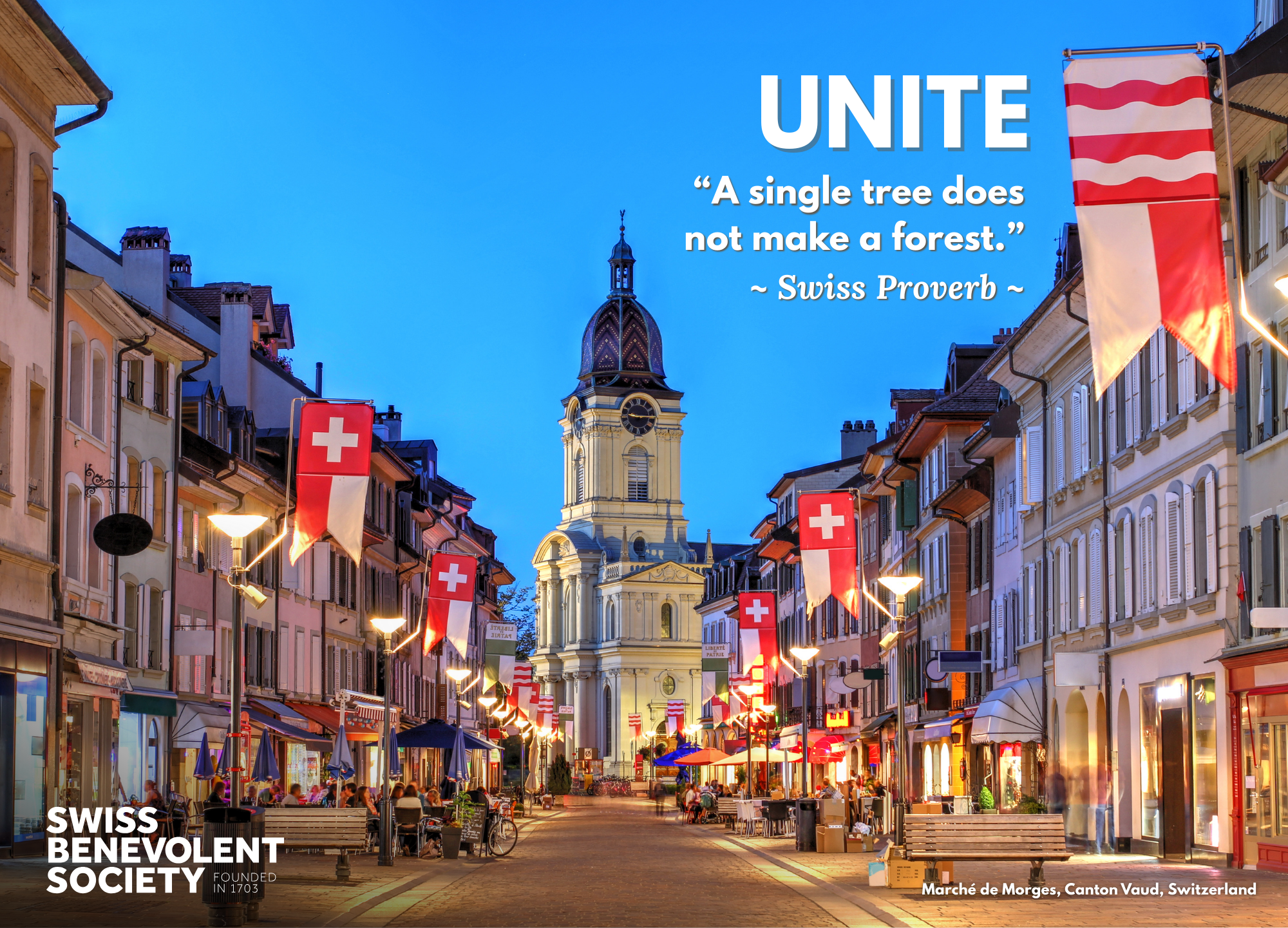
August – UNITE
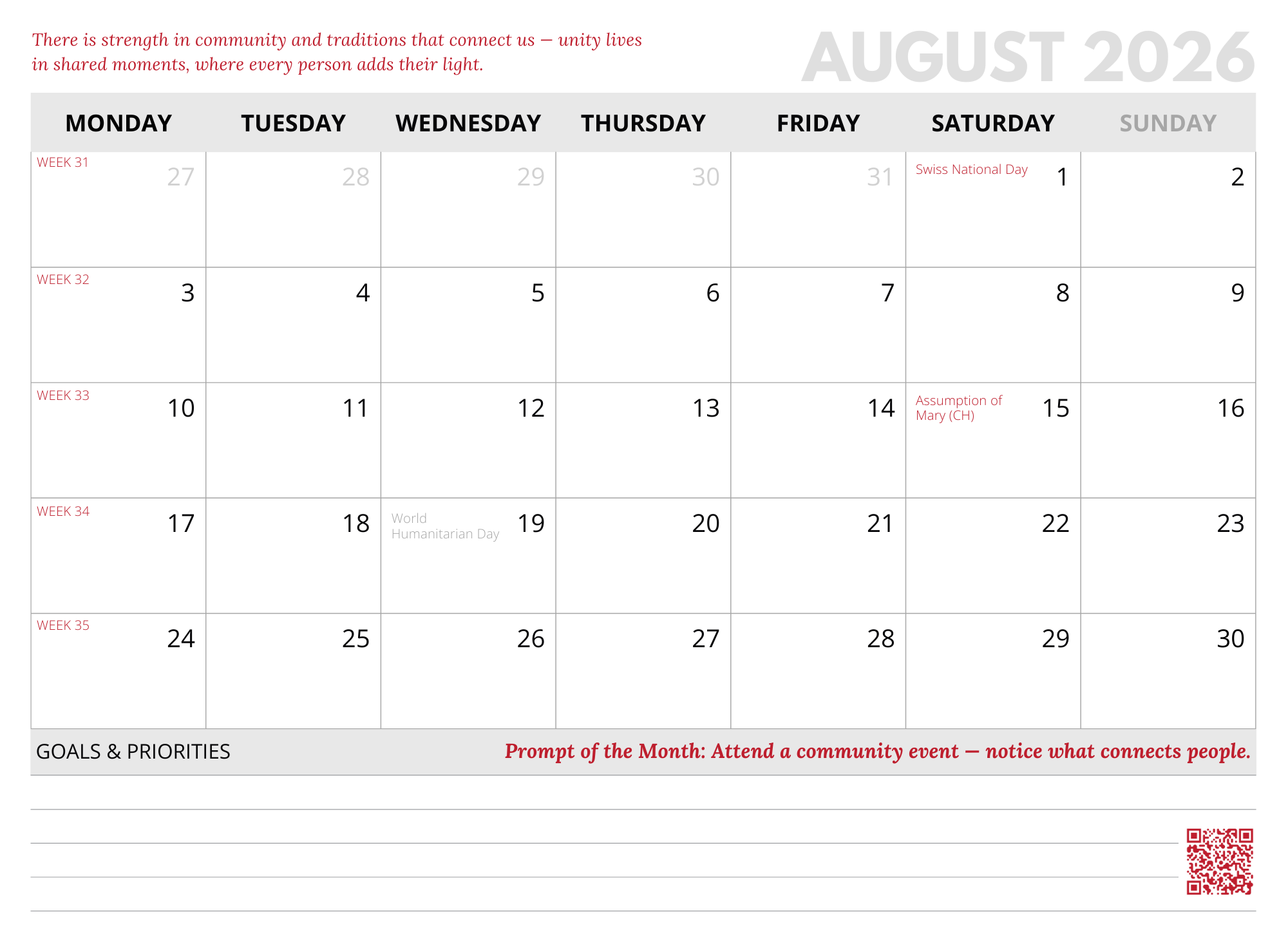
Prompt of the Month: Attend a community event — notice what connects people.
Think of the last time you stood in a room full of people and felt, without anyone announcing it, that you were among your own. Perhaps it was a wedding, a church hall, a school fair, a club evening. Perhaps it is this very Saturday: the annual Swiss National Day celebration, held this year at the Crypt on the Green in Clerkenwell, where laughter rises over the raclette, children weave between tables playing games nobody fully explained to them, and two people who met over a plate of Bratwurst discover they grew up three villages apart. Someone will arrive alone and leave three hours later with two phone numbers and an invitation to a coffee morning. Whatever the room, something happens in it that does not happen when we are on our own.
August gives that something a name. The calendar gives the month a single word, UNITE, and a Swiss proverb that says most of what needs saying:
“A single tree does not make a forest.”
~ Swiss Proverb ~
August’s calendar reads:
“There is strength in community and traditions that connect us — unity lives in shared moments, where every person adds their light.”
Proverbs earn their long lives by being tested, and this one is not a sentiment about togetherness being pleasant. It is a claim about survival. A tree standing alone takes the full force of the wind. A forest breaks the wind for every tree in it, and beneath the surface the roots share water where nobody sees. The question August asks is a practical one: where is your forest, and when did you last stand in it?
From Connect to Unite – A Thought from Lily, Our Welfare Officer
Community has always been important to me…
Having lived in Switzerland and grown up with a mixed English and Peruvian background, as well as spending time in France, I have developed an appreciation for the rich traditions, celebrations and sense of community found across each of these cultures. Whether it is gathering around a raclette dinner in Switzerland, learning how to prepare ceviche with my dad, or sharing an apéritif on a warm French summer evening, I have experienced the joy that comes from bringing people together and creating spaces where people feel they belong.
Some of my favourite memories of Switzerland are walking through Geneva’s Old Town, watching the Jet d’Eau rise above the lake, and looking up in awe as the fireworks light up the sky on Swiss National Day. Yet what stays with me most is not the places themselves, but the people and the feeling of being welcomed. I’ve been fortunate to find that same warmth across all of these communities, and it has reminded me that connection often begins with the simplest things: sharing a meal, dancing, or coming together around a common purpose. Whether it is neighbours gathering around a table or supporters from every corner of the world united during the World Cup, those shared moments have a remarkable way of bringing people together. They have taught me that a sense of belonging isn’t built because everyone is the same; it’s created when people make room for one another.
To me, that is what Unite means. It isn’t about sharing the same background or traditions, but about finding common ground while celebrating what makes each of us unique. A true sense of belonging gives us the confidence to be ourselves while also allowing us to learn from one another. When we come together with open hearts and open minds, we don’t lose our individual identities—we strengthen the community we build together.
Belonging Starts with Showing Up
A sense of belonging often takes time to develop. We might expect to feel accepted before approaching a community, but in reality it is often the other way around. Simply showing up, even if we feel a little out of place at first, is often the beginning of finding the familiarity and connection that allow a sense of belonging to grow.
The first step is often the hardest. Walking through the door to an event, introducing yourself to someone new, or accepting an invitation can feel daunting. It takes courage, but those small steps are where belonging begins. By taking part, we create the opportunity for connection to develop over time.
In many ways, this has been the story of the Swiss Benevolent Society throughout its history. When the Société des Suisses was founded in London in 1703, its community was built on a shared commitment to care for one another. Those facing illness, hardship and old age were supported with the understanding that these challenges were easier to face together. Over more than three centuries, that same principle has continued to evolve as the needs of the community have changed.
In the nineteenth century, support centred on new arrivals from some of Switzerland’s poorest regions seeking work in London. During periods of economic hardship in the early twentieth century, the Society adapted again. In the 1960s, Welfare Officers met young Swiss au pairs arriving at Victoria Station, helping them navigate an unfamiliar city and ensuring they had someone to turn to. Today, our work more often focuses on supporting older members of the Swiss community, which is reflected in traditions such as our annual Tea Party celebrating those reaching their 80th, 85th, and 90th birthdays and beyond.
Across every generation, one lesson has remained constant: communities are strengthened not by extraordinary moments but by ordinary acts of care. Knowing someone’s name. Noticing when they have not been seen for a while. Picking up the phone. Knocking on a door. These small gestures weave together the relationships that help people feel connected and supported.
There is an old proverb that says a chain is only as strong as its weakest link. A community’s resilience depends on how it cares for its most vulnerable members. When people facing illness, loneliness or hardship are supported, everyone benefits because trust grows, connection deepens and no one is left to face difficult times alone. Welfare work is not something that sits at the edges of community life; it is one of the ways community is sustained.
This feels particularly fitting as we mark World Humanitarian Day on 19 August. While few of us will ever work in humanitarian emergencies, its message reaches far beyond global crises. It reminds us that another person’s wellbeing is never solely their own concern. Whether through volunteering, checking in on a neighbour or simply welcoming someone new, each of us has the opportunity to help create the kind of community where everyone has the chance to belong.
The First of August, Keeping Traditions Alive
If any date on the Swiss calendar reflects this month’s theme, it is the first of August. The day commemorates the Federal Charter of 1291, an agreement between three small communities that recognised they were stronger working together than apart. In Switzerland, the day is marked by bonfires on the hillsides, paper lanterns and brunches on farms. Here in the UK, it means something just as important: people who could easily let the day pass by choosing instead to come together, celebrate their shared heritage and strengthen the connections that keep a community alive.
This summer brought a glimpse of that feeling when Switzerland reached the quarter-finals of the World Cup for the first time since 1954, bringing Swiss people together across the country and beyond. The first of August offers another opportunity to come together, with celebrations around the world creating spaces to share Swiss culture, traditions and community.
This year’s London celebration takes place on Saturday 1 August, from 2pm to 6pm at Crypt on the Green, St James Church, Clerkenwell Close, London EC1R 0EA. More information about the day can be found at snd-london.com.
The Swiss Benevolent Society will be there, bringing more than just a banner. Our Welfare Officer, Lily, will be at our stand throughout the afternoon: meeting compatriots, answering questions about the work we do, or simply offering a familiar face to anyone navigating the room alone. She will also be hosting a wellbeing beading session, a hands-on activity open to anyone who would prefer to have something to do while a conversation begins.
We attend for a simple reason: a stand at a community event is welfare work in its most welcoming form. Many of the people our office later supports first meet us through moments like this — a conversation, an introduction, or simply knowing there is someone there to turn to. As every year, tickets for the official celebration sold out early; if you have secured yours, please do come and say hello. We look forward to sharing our impressions of the day, along with Lily’s reflections from the stand, through our social channels and in the September newsletter.
On 15 August, families from the Catholic cantons will also continue to mark the Assumption, sharing this tradition with neighbours and friends who might not have encountered it before. These traditions are not simply preserved as memories of the past; they continue because people practise them, adapt them and pass them on. Living between two countries means traditions naturally change, but their meaning remains. Through these everyday acts of connection, people create a sense of belonging rather than simply inherit one.
A Practical August Experiment
This month’s prompt asks you to attend a community event, and to notice what connects people.
Not what should connect them, but what actually does: the queue where conversations start, the child who breaks the ice between two tables, the question “where in Switzerland are you from?” that opens twenty minutes of geography. Connection at this scale is observable, and observing it is the first step to creating it.
The question is not: Do I feel like going? The question is: What happens if I go anyway?
Here are four ways you might act on it:
- Attend one gathering you would normally talk yourself out of. A street fair, a church coffee morning, a Swiss club evening, the event on the library noticeboard. Go without a job to do, and without a companion if none is available. Stay one hour.
- Notice, and name, one thing that connected people. Afterwards, finish this sentence in a notebook or in your head: “What connected people today was…” Food? A task? A shared complaint about the trains? Naming it teaches you how connection actually works, which makes it easier to create next time.
- Extend one invitation. Forests grow at their edges. Think of one person who was not in the room, the new arrival, the neighbour widowed last year, the student spending August far from home, and invite them to the next thing you attend.
- Mark a results day for someone. If a young person you know receives exam results this month, send a message the evening before that says nothing about grades and everything about them being valued either way. If the news is hard, your steadiness will matter more than your advice.
That last one is worth a moment more. Results days across the UK, with SQA results in Scotland on 4 August, A-level results in England, Wales and Northern Ireland on 13 August, and GCSE results on 20 August, can look like individual milestones, but they are often shared experiences. Behind every result is a network of people waiting, supporting and encouraging: families holding their breath, grandparents checking in from another country, and communities ready to celebrate or offer support when things do not go as planned. If your family is Swiss and the next step raises questions about funding, our student grants and bursary programmes are available to help. Please share this information with anyone who may benefit.
Closing Reflection
A single tree does not make a forest, and a community is built in the same way: through people showing up for one another. A conversation at an event, a coffee shared with someone new, or a simple message of support can all make someone feel less alone.
For those of us building lives between countries, distance often deepens our connection to where we come from. Traditions, language and shared experiences take on new meaning, and they become the foundations on which communities abroad are built. The rooms we gather in today were not created overnight; they were built by generations of people who kept showing up, turning strangers into neighbours and communities into places of belonging. The Society has been part of that journey since 1703, continuing to adapt, learn and welcome everyone who wishes to be part of it.
Find your forest and stand in it.
And carry on.
Join Our 2026 SBS Year of Steady Progress
This journey continues through our monthly blog, where each theme will come to life with practical insights, reflections, and coaching tools to help you stay steady through the year.
Accessing the Calendar
To ensure everyone in our community can take part, we have made the full PDF version of the SBS 2026 Wall Calendar available to download for free on our website.
If you would prefer a hardcopy, you are very welcome to contact our office. We will be happy to post one to you. We currently have a limited number of printed copies remaining, available on a first-come, first-served basis; in return, we would gratefully appreciate a Donation of any amount. As always, 100% of proceeds go directly back into the SBS Welfare Fund, supporting Swiss nationals in the UK who need us most.
👉 Download the PDF: SBS 2026 Calendar A4
👉 Request a hardcopy: info@swissbenevolent.org.uk
READ OUR OTHER BLOGS HERE:
- Beneath the Noise: An October Reflection on GROUND
- Disconnect to Reconnect: A Digital Wellbeing Afternoon in London
- Given Away, Not Gone: A September Reflection on Share
- Where the Forest Begins: An August Reflection on Unite
- Annual Summer Office Break
About the Swiss Benevolent Society
The Swiss Benevolent Society exists to support Swiss nationals in the UK through times of change, challenge, and transition. Our work is grounded in dignity, compassion, and the belief in self-reliance — offering practical help while empowering individuals and families to regain stability and confidence. If you or someone you know may need support, you can learn more about how we help and how to get in touch through our Welfare Office. If you share our values and would like to be part of our community, we welcome you to become a member and stay connected with our work. And if you are able, donations — of any size — help us continue providing vital assistance; every contribution goes directly back into our welfare programmes.
Stay Connected
Follow us on Facebook, Instagram or LinkedIn for monthly reflections, book highlights, and gentle wellbeing reminders.
Subscribe to our newsletter to receive each month’s theme directly in your inbox.
If you are able, donations help sustain our welfare work and ensure we can continue supporting Swiss nationals in the UK. Every contribution makes a difference.