The Art of Rebalancing Life: Navigating Change Through Small Everyday Choices
Tuesday, March 31st, 2026
March – BLOOM
We are in a season that has a particular way of shifting the mood of a city. One week people are still wrapped in winter coats, shoulders slightly hunched against the cold, and then suddenly the light changes. Café chairs appear outside again, blossoms catch the afternoon sun between rows of houses, and someone lingers a little longer at a crossing rather than rushing straight through.
The surroundings look familiar, yet something in the atmosphere invites a small recalibration. In Britain, the first appearance of the sun is often greeted with the enthusiasm normally reserved for a celebrity sighting. One bright afternoon is enough to trigger a citywide wardrobe shift. Polo shirts reappear, sandals cautiously venture out, and someone will inevitably be spotted eating ice cream while the temperature hovers around nine degrees. Spring, in this sense, becomes less about the weather and more about collective optimism, supported by a fair amount of thermal denial.
Seasonal changes are easy to recognise. They arrive with blossom, longer evenings, and the quiet sense that something is moving forward. Personal balance, on the other hand, unfolds more slowly. While the season outside shifts with confidence, many people find themselves adjusting to changes that happened earlier, sometimes months or even years before the world around them seemed to catch up.
Some changes arrive with a clear beginning, a move to a new place, the end of a long career, or the quiet reshaping of family life. Others are subtler and reveal themselves through the structure of ordinary days. A morning routine that once revolved around a train platform slowly disappears. Evenings grow quieter when children become more independent. Habits linger long after the circumstances that created them have changed.
It is often through these small details of daily life that we realise something has shifted.
The event itself may pass quickly, while the adjustment that follows unfolds far more gradually. Life reorganises itself through small decisions made day by day.
Living in the In-Between
Anyone who has experienced a meaningful transition will recognise the peculiar period that follows, the time when the old structure of life has loosened but the new one has not yet fully taken shape.
Psychologists Margaret Stroebe and Henk Schut describe this rhythm in what is known as the Dual Process Model. Their work suggests that people naturally move between two different states of attention. One part of us turns toward what has changed or what we miss, while another part begins rebuilding everyday life through ordinary routines and responsibilities.
These shifts do not follow a straight line. A reflective morning may be followed by an afternoon filled with practical tasks. One week brings nostalgia, the next the quiet discovery that new rhythms are beginning to form. Seen from a healthy distance, these shifts resemble less a problem we need to solve and more a rhythm we gradually learn to understand and live with.
Let us compare this phase to standing in a corridor between two rooms. The door behind us has closed, the door ahead has not yet opened, and for a time we simply learn to stand in the space between. Yes, it can feel uncertain, yet much of life’s real adjustment happens in that corridor. In many ways it becomes a place of preparation, where we gather ourselves quietly before stepping into what comes next.
The Small Adjustments That Restore Balance
When life shifts, the instinct is often to search for a decisive solution, something that restores order quickly and makes everything feel settled again. In reality, balance does not return in a single moment. More often it rebuilds itself quietly through new routines that begin to shape everyday life.
Consider how this can unfold in practice. A morning once structured around a train commute might gradually become a walk through the neighbourhood instead. Evenings that revolved around family dinners may evolve into time spent reading, volunteering, or revisiting an interest that had long been set aside.
From the outside these adjustments can look almost insignificant. Yet they serve an important purpose. Small routines repeated over time create new habits, and habits restore a sense of predictability. It is this predictability that slowly rebuilds a feeling of steadiness after change.
What makes this process confusing is the way our minds interpret it. When circumstances shift, we often continue operating on assumptions that belonged to a previous phase of life, and we expect everything to feel “back to normal” much sooner than is realistic. In that gap, uncertainty can easily be mistaken for failure. Psychologists describe these mental shortcuts as cognitive biases; patterns of thinking that once helped us navigate familiar situations but may no longer fit the new reality.
In truth, adaptation has its own rhythm. Balance emerges gradually as new habits replace old ones, our thinking slowly adjusts to the new reality, and everyday life quietly finds its footing again.
Gentle Practices for April – Paying Attention to What Nourishes You
This month’s reflection prompt invites a simple but revealing exercise.
Notice what drains you and what nourishes you.
The answers tend to appear in small details scattered throughout the day. An obligation that consistently feels heavier than it should. The impulse to react or comment on everything, even when it only adds more tension. Or a quiet moment outdoors that settles the mind more effectively than an hour of scrolling through a phone.
Research into wellbeing repeatedly shows that happiness is shaped less by grand resolutions and more by modest adjustments to daily habits. Protecting a few restorative routines, adjusting small behaviours, and letting go of expectations that no longer fit can gradually reshape the rhythm of a day.Approaching life this way turns everyday experience into a gentle experiment. Instead of chasing perfect balance, we begin to notice where energy returns naturally and where it quietly disappears. These small observations also help us regulate more wisely, because our energy does not remain constant. Like the seasons around us, it moves through phases, and learning to work with that rhythm often restores more balance than forcing ourselves into one fixed pace.
Where to Begin with This Month’s Reflection:
The aim this month is not to solve life’s complexities but to observe them with curiosity.
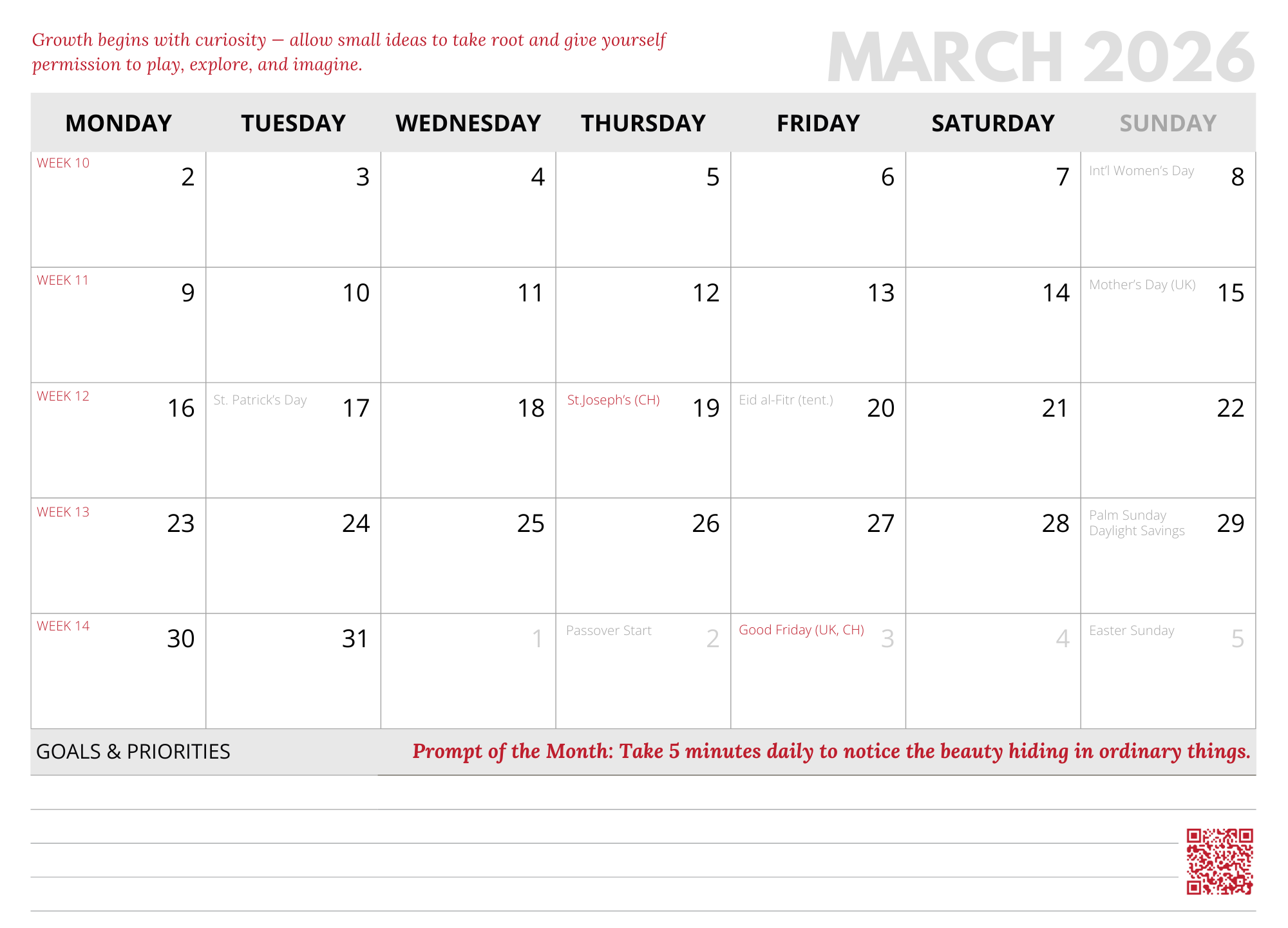
- You might begin by noticing the rhythms of your day. Which moments bring a sense of calm or satisfaction? Which obligations consistently leave you depleted?
- Consider whether any routine you follow today belongs to an earlier phase of life. Letting go of one outdated habit can create surprising space.
- At the same time, reintroducing something small that once restored you, an evening walk, time with a book, a regular conversation with a friend, can quietly stabilise busy weeks.Adjustment grows through these quiet decisions repeated over time.
📚 This Month’s Good Reads
These recommendations explore different ways of navigating change, rebuilding perspective, and restoring balance in everyday life.
TRANSITIONS: MAKING SENSE OF LIFE’S CHANGES – WILLIAM BRIDGES
A widely respected guide to understanding the psychological process that follows major life changes. Bridges explains how people move through endings, periods of uncertainty, and eventually toward new beginnings.
Why it fits April: Periods of transition often place us in that “in-between corridor” where the old structure of life has ended but the new one is still forming.
Best for: Readers navigating relocation, retirement, career shifts, or any moment where life is quietly reorganising itself.
🔗 https://www.goodreads.com/book/show/293154.Transitions
THE ART OF THINKING CLEARLY – ROLF DOBELLI
Swiss author Rolf Dobelli explores the subtle thinking patterns and cognitive biases that shape our decisions, often without us noticing. In this highly readable book, he explains common biases through short, practical examples that quietly hold a mirror up to our everyday thinking. Many chapters lead to genuine “aha” moments, and at times you almost feel caught in the act, because most of us like to believe we are far more objective than we actually are.
Why it fits April: During periods of change it becomes easy to misinterpret uncertainty as failure. Learning to recognise our thinking biases can restore perspective and bring a welcome sense of calm.
Best for: Professionals, students, and curious readers who enjoy understanding how the mind influences everyday judgement.
🔗 https://www.goodreads.com/book/show/16248196-the-art-of-thinking-clearly
THE HAPPINESS PROJECT – GRETCHEN RUBIN
In this engaging year-long experiment, Gretchen Rubin sets out to explore what actually makes everyday life happier and more meaningful. The idea begins with a simple realisation during an ordinary bus ride: time passes quickly, yet we often overlook the things that matter most. Over twelve months, Rubin tests small adjustments to habits, routines, and surroundings, discovering how modest changes can have a surprisingly powerful impact on wellbeing.
Why it fits April: Balance is often restored through modest shifts in routine rather than dramatic life changes.
Best for: Readers looking for practical inspiration to reshape everyday habits and routines.
🔗 https://www.goodreads.com/book/show/6398634-the-happiness-project
📖 Prefer to borrow instead of buy?
Many of these books are available for free through local libraries. If you prefer to borrow rather than buy, you can search for nearby copies via WorldCat at local libraries via:
👉 https://www.worldcat.org
Closing Reflection
Balance is not a fixed state that can be achieved once and then maintained forever. More often it develops subtle, through observation, patience, and the small adjustments we make as life changes around us.
This month we used April as a gentle reminder to pause and notice where your energy is being spent and where it seems to return naturally. Some routines may still support you, while others may belong to a chapter that has already run its course. The art lies in recognising the difference, and that alone is often enough to allow life to settle into its next rhythm.
Give the process a little time.
And carry on.
Join Our 2026 SBS Year of Steady Progress
This journey continues through our monthly blog, where each theme will come to life with practical insights, reflections, and coaching tools to help you stay steady through the year.
Accessing the Calendar
To ensure everyone in our community can take part, we have made the full PDF version of the SBS 2026 Wall Calendar available to download for free on our website.
If you would prefer a hardcopy, you are very welcome to contact our office. We will be happy to post one to you. We currently have a limited number of printed copies remaining, available on a first-come, first-served basis; in return, we would gratefully appreciate a Donation of any amount. As always, 100% of proceeds go directly back into the SBS Welfare Fund, supporting Swiss nationals in the UK who need us most.
👉 Download the PDF: SBS 2026 Calendar A4
👉 Request a hardcopy: info@swissbenevolent.org.uk
READ OUR OTHER BLOGS HERE:
- The Art of Rebalancing Life: Navigating Change Through Small Everyday Choices
- Welcoming Our New Welfare Officer, Lily
- What If Growth Started with Curiosity? A Spring Reflection on Blooming
- Listening, Language, and the Quiet Work of Connection
- Renewal Begins with One Intentional Step
About the Swiss Benevolent Society
The Swiss Benevolent Society exists to support Swiss nationals in the UK through times of change, challenge, and transition. Our work is grounded in dignity, compassion, and the belief in self-reliance — offering practical help while empowering individuals and families to regain stability and confidence. If you or someone you know may need support, you can learn more about how we help and how to get in touch through our Welfare Office. If you share our values and would like to be part of our community, we welcome you to become a member and stay connected with our work. And if you are able, donations — of any size — help us continue providing vital assistance; every contribution goes directly back into our welfare programmes.
Stay Connected
Follow us on Facebook, Instagram or LinkedIn for monthly reflections, book highlights, and gentle wellbeing reminders.
Subscribe to our newsletter to receive each month’s theme directly in your inbox.
If you are able, donations help sustain our welfare work and ensure we can continue supporting Swiss nationals in the UK. Every contribution makes a difference.