The Half-Second That Changes Everything: A June Reflection on Embrace
Thursday, June 4th, 2026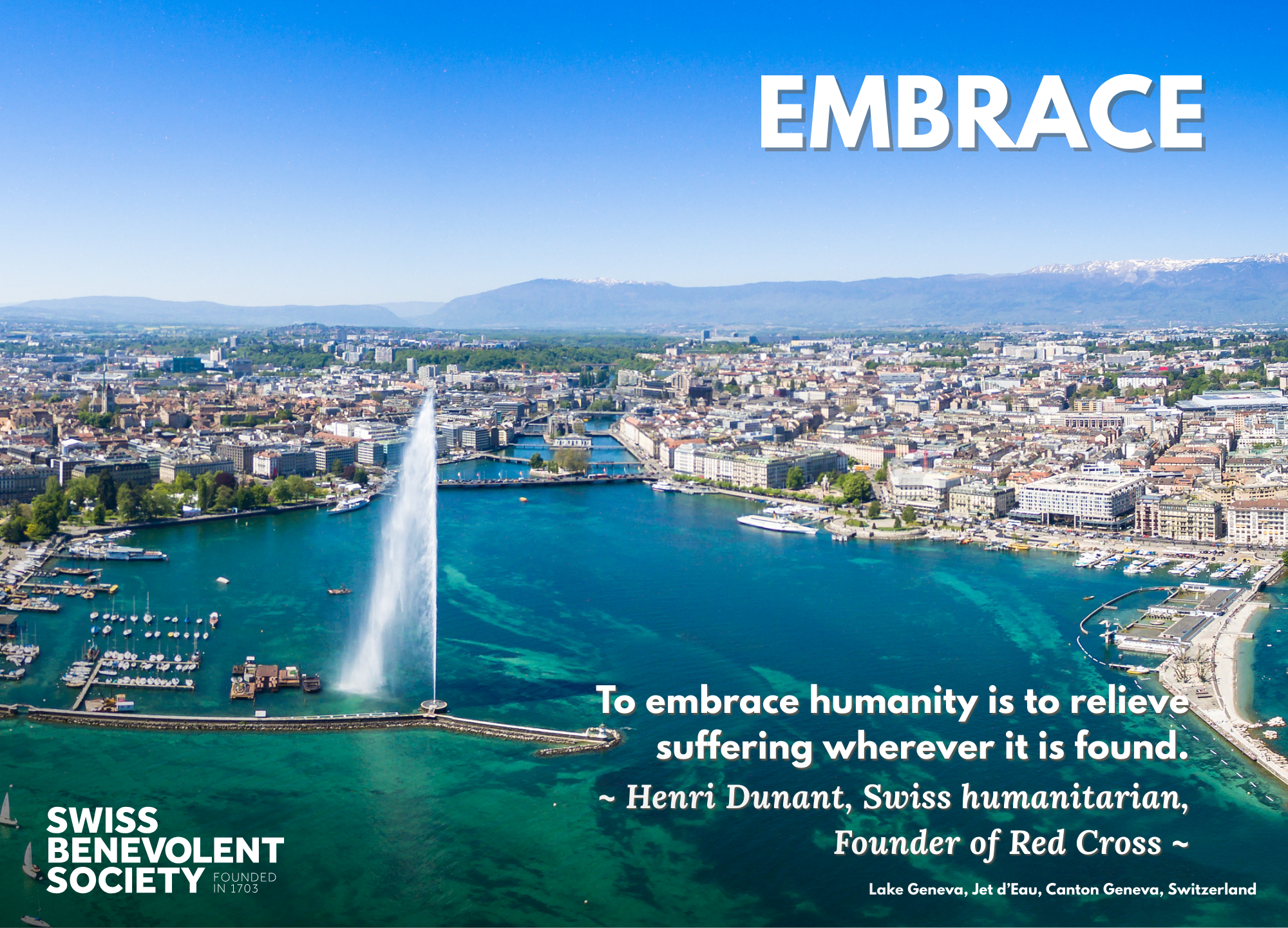
June – EMBRACE
Strength That Stays Present
Prompt of the Month Pause before you react — and choose patience, with others and yourself.
In June 1859, a Swiss businessman named Henri Dunant was travelling through northern Italy, hoping to secure a meeting with Napoleon III. What he encountered instead was the human cost of the Battle of Solferino — more than 40,000 people killed, wounded, or missing across open fields, with almost no organised medical care available to any of them.
Dunant had no training, no authority, and no mandate to act. He was a merchant from Geneva, not a soldier or a doctor. What he had was the refusal to look away — and the steadiness, in the middle of something overwhelming, to begin organising practical care rather than be consumed by the scale of it. He rallied the women of nearby villages, gathered what supplies could be found, and insisted on treating the wounded without distinguishing between nationalities. He stayed when he could have left.
In 1863, the committee that would become the International Committee of the Red Cross was founded in Geneva.
This story does not belong to June because it invites us to compare ordinary life to a battlefield. It belongs here because it clarifies something important about what embrace actually requires. It is not sentiment. It is not warmth alone. It is the capacity to remain present — to choose not to withdraw, not to react blindly, not to be swept up in whatever is happening — and to respond from steadiness rather than from urgency. Dunant’s act began with an extraordinarily ordinary decision: not to turn away from what was in front of him.
That decision is available to all of us. What June’s theme asks is whether we are making it.
After May’s question — does the life we organise also sustain us? — June asks what we do with that sustenance. Once the routine contains enough nourishment to support us, we have more to extend outward. Embrace is what becomes possible when we are not running entirely on depletion.
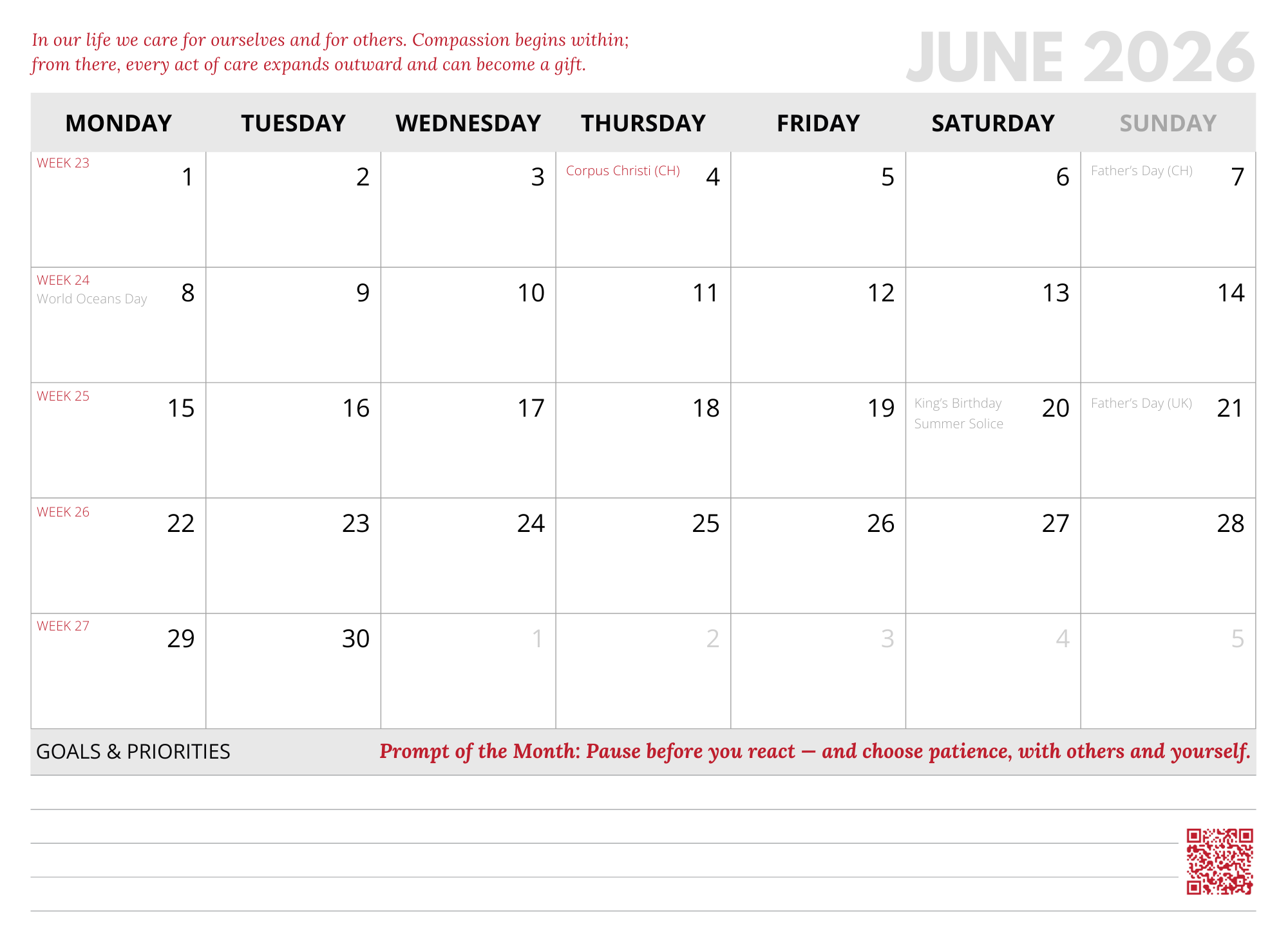
The June calendar captures this movement:
In our life we care for ourselves and for others. Compassion begins within; from there, every act of care expands outward and can become a gift.
The challenge is that compassion is easiest when everyone is behaving reasonably. The real practice begins when they are not.
Embrace Is Not What It Sounds Like
The word suggests warmth, closeness, easy acceptance. The act is considerably more demanding.
To embrace something — a difficult person, a conversation that keeps going wrong, your own impatience at the end of a long week — requires holding it carefully without either tightening your grip until something breaks or letting go because it has become uncomfortable. That takes more steadiness than warmth alone can provide.
It is worth being clear about what embrace, in June’s sense, is not. It is not people-pleasing. It is not absorbing everyone else’s distress until you have nothing left. It is not the suspension of your own needs in permanent service to others. Those things are not compassion — they are depletion dressed up as generosity, and they tend to end in resentment rather than care.
In high-pressure environments — professional, expat, student — the default response to difficulty is control: manage the outcome, fix the situation, correct the person, prevent the thing from going wrong. Much of the most exhausting emotional expenditure in modern life goes toward trying to influence things that are not ours to control.
So. how can navigate situation like this? Embracing the fact that not everything is in our control — not everything is as we wish it were, not as it would be if other people behaved differently — and to choose, from that clear-eyed position, how we respond to it. The situation does not change. Our relationship to it does. And that shift, from resistance to acceptance, from friction to steadiness, turns out to be a surprisingly effective tool for handling exactly the moments that would otherwise derail us. The colleague who does things differently. The system that does not work the way it should. The plan that changed without warning. When we stop spending energy fighting the fact of it and redirect that energy toward deciding what we will do next, we recover our agency rather than surrendering it.
That distinction matters for June. Embrace is not the act of holding on to everything. It is the act of deciding, deliberately, what deserves to be held — and meeting what does not with enough steadiness to let it be what it is.
The Half-Second
Many relationship ruptures begin in moments of haste: the reply sent before the full message was read, the assumption made before the explanation arrived, the withdrawal that the other person experiences as rejection when what it actually is, is overwhelm. Or the critical thought directed at ourselves before we have properly understood what happened.
None of these require much time. They occur in a half-second. And they can be changed in a half-second — if that half-second contains a pause.
In Parenting from the Inside Out, psychiatrist Daniel Siegel and educator Mary Hartzell explore how a parent’s own childhood experiences can shape the way they respond to their children — often without being fully aware of it. Their book suggests that our sharpest, most impatient reactions are frequently not responses to what is happening in front of us. They are responses to something older — something carried from our own history that the current moment has accidentally resembled. The child who does not listen stirs a memory of not being heard. The colleague who dismisses your work touches something from long before that workplace existed. The patience runs out not because of the present situation alone, but because of everything it rhymes with.
They describe this as “making sense of your own story” — the understanding that when we examine where our reactions come from, we become less governed by them. We stop responding to the past and start responding to what is actually here. For parents, this has immediate implications for how they engage with their children under pressure. But the principle extends further: any relationship benefits when the person inside it is meeting the present moment rather than replaying an older one.
The pause June’s prompt is asking for is not a pause for politeness. It is the moment where choice becomes available. You cannot always prevent the first reaction. But you can decide what you do with it.
Where Embrace Shows Up in Ordinary Life
The shape of embrace shifts considerably depending on the stage of life someone occupies.
For students and young professionals navigating demanding environments, the impulse to manage everything — outcomes, perceptions, other people’s expectations — is both understandable and relentless. We often drain our energy trying to control what the work will mean to others, and what others will do in response. Learning to release that — to do the work, hold your own standards, and let others respond as they will — is not resignation. It is the kind of boundary that preserves the energy needed to do good work over time. For Swiss nationals studying or working in a foreign system, often without the support networks that would exist back home, that energy management is not a luxury. It is a necessity.
For families navigating school runs, homework, exam pressure, and the particular density of a household where everyone’s emotional weather system is affecting everyone else’s — the pause is hardest to find precisely when it is most needed. Siegel and Hartzell’s book does not promise that greater self-knowledge will make parenting easier. It promises something more realistic: that the more you understand your own patterns, the less frequently your children have to manage the consequences of them. That is a different kind of embrace — the willingness to look inward with honesty rather than self-criticism, for the sake of the people who live alongside you.
Later in life, the question of embrace takes on a different weight. Robert Seethaler’s short novel A Whole Life follows Andreas Egger from impoverished childhood through physical labour, love, devastating loss, war, and eventually old age — all set in the unforgiving landscape of the Alps. What is extraordinary about the book is not Egger’s resilience in any motivational sense. It is his clarity. He does not approve of the tragedies that visit him. He does not pretend they did not happen, or that they happened for a reason. He meets each phase of his existence with a steadiness that never tips into either bitterness or false comfort.
There is a distinction the novel makes visible that is worth naming directly: approval and acceptance are not the same thing. Approval says this is good. Acceptance says this is true. Only after we have acknowledged what is true can we decide how to live within it — and that decision, made with clarity rather than reluctant endurance, is what Seethaler’s Egger demonstrates across a lifetime.
For Swiss nationals who have spent decades building a life in the UK — who have done the work of belonging in two places simultaneously, who carry two calendars and two versions of home — that image carries particular resonance. The capacity to be fully present in the life you are living, rather than the one you planned or the one you left behind, is one of the more demanding, and more rewarding, forms of embrace available. Some will feel entirely at home in the UK. Others will feel permanently between places. Both are valid — and both are lives worth inhabiting fully.
Compassion That Moves Outward
There is a risk that ideas like self-care, boundaries, and acceptance become entirely private projects. We protect our energy. We work on our reactions. We learn to let go. All of this can be useful. But compassion that never travels beyond the self becomes incomplete.
When we understand our own limits, we are less likely to offer help with resentment attached to it. When we stop trying to control others, we become more available to actually listen to them. When we accept that life can be difficult, we are less surprised by another person’s struggle — and therefore more able to stay present with them rather than retreating.
At the Swiss Benevolent Society, embrace does not mean taking over another person’s life. It may begin with listening carefully, helping someone understand a difficult process, offering practical support during a period of uncertainty, or standing alongside someone while they regain stability and confidence. The purpose is not rescue. It is the kind of steady, humane presence that protects dignity and strengthens a person’s ability to move forward. That, too, is a form of embrace — and it is what this community has been built on for more than three centuries.
A Practical Experiment for the Month Ahead
April was an invitation to notice — what drains you, what restores you. May asks the logical next qJune does not ask for a transformation. It asks for one small, practised decision each week — the pause before the reaction. Three questions can anchor it:
Is this mine to control? Another person’s opinion, mood, or decision may not be yours to manage. You may still need to respond, but you do not need to carry responsibility for both sides of the situation.
What is this moment stirring in me? A strong reaction may be giving you useful information. Are you tired, feeling dismissed, responding to the present moment or to something it resembles? Naming the feeling does not make it disappear, but it can prevent the feeling from choosing your words for you.
What response will I respect later? Patience is not the same as silence. A respectful response may be a clear boundary, an honest conversation, or the decision not to continue an exchange that has stopped being useful. The goal is to respond deliberately rather than automatically.
Beyond those questions, consider one of these each week across the month:
- Pause before replying to a message that irritated you. Read it again. Wait an hour. See whether the reply you send is the same as the one you would have sent immediately.
- Allow one person to make a different choice without immediately trying to persuade them. Give them the dignity of their own decision.
- Pause before criticising yourself for something that cannot be changed today. Self-compassion is not self-indulgence — it is the foundation from which steadiness grows.
- Reach out to someone whose life may have grown quieter than usual. The most significant act of embrace is sometimes simply the decision to stay present.
The experiment is not to get all four right. It is to notice, over the course of the month, what the pause actually feels like — and whether the response you choose inside it is different from the one that would have come without it.
📚 This Month’s Good Reads
These recommendations explore different dimensions of embrace — from practical boundary-setting in high-pressure environments and the neuroscience of patient parenting to one of the most profound fictional portraits of a life met with clear-eyed steadiness. You do not need to read all three. Choose the one that speaks most clearly to your present season, or pass the list on to someone who may find one of them useful. We would love to know which idea stays with you as you read.
PARENTING FROM THE INSIDE OUT — DANIEL J. SIEGEL & MARY HARTZELL
Drawing on neuroscience and professional experience, Siegel and Hartzell show that the moments when patience fails most dramatically are frequently not responses to the child in front of us but echoes of our own earlier experiences. The insight shifts the problem entirely: it is not about trying harder to be patient, but about developing enough self-knowledge to stop confusing the past with the present. The argument extends well beyond parenting.
Why it fits June: The book is a thoughtful guide to the pause that June’s prompt is asking for. It explains why creating space in the half-second before a reaction is not simply a matter of willpower — and offers a more sustainable path to steadiness.
Best for: Families, parents, and carers — and anyone who has noticed that their sharpest reactions to other people feel strangely familiar, as though they have had this conversation before.
Reading prompt: Which situations tend to produce a reaction that feels larger than the moment itself — and what might they be telling you about something older?
🔗 https://www.goodreads.com/Parenting_from_the_Inside_Out
A WHOLE LIFE — ROBERT SEETHALER
Set in the Alpine landscape — a world that will feel immediately legible to Swiss readers — this short novel follows one man’s life from childhood poverty through labour, love, war, and old age. What Andreas Egger demonstrates is not resilience in any motivational sense but something rarer: the capacity to meet each phase of life with clear-eyed steadiness, without requiring it to be something other than it is. Under two hundred pages. Its effect lasts considerably longer.
Why it fits June: Egger’s life is an extended portrait of embrace in the deepest sense — the distinction between approval and acceptance, between enduring and being present, between the life we were given and the life we imagined. For readers who find the June theme abstract, this novel makes it concrete and deeply human.
Best for: Readers at any stage of life — and particularly those navigating significant change, loss, or the experience of having built a life somewhere that was never quite home, or discovering that home has become more than one place.
Reading prompt: Where might acceptance create more dignity and freedom than continued resistance — and what would it mean to acknowledge what is true without requiring it to be good?
🔗 https://www.goodreads.com/A-whole-life
📖 Prefer to borrow instead of buy?
Many of these books are available for free through local libraries. If you prefer to borrow rather than buy, you can search for nearby copies via WorldCat at local libraries via:
👉 https://www.worldcat.org
Closing Reflection
Embrace is not a permanent state. It is a decision that gets made in small moments, across ordinary days, more or less well depending on how sustained the person making it happens to be.
June invites us to look at those moments with fresh attention — not to judge the reactions we have been having, but to notice them, understand them a little better, and begin to create just enough space to choose something different. The pause is not the goal. It is the doorway to the goal: a response that comes from steadiness rather than habit, from the present rather than the past, from genuine care rather than depletion dressed as generosity.
Henri Dunant’s example reminds us that compassion becomes meaningful when it moves from feeling into practical action. What he demonstrated at Solferino was not extraordinary warmth. It was the refusal to be indifferent — and the steadiness to act on that refusal in the middle of something overwhelming.
The version of that available to most of us this month is considerably smaller in scale. A conversation held more carefully. A reaction reconsidered. A person stayed with rather than left behind. An evening extended toward someone who needed the company.
Small decisions. Genuine ones.
Tend to the space before you react.
And carry on.
Join Our 2026 SBS Year of Steady Progress
This journey continues through our monthly blog, where each theme will come to life with practical insights, reflections, and coaching tools to help you stay steady through the year.
Accessing the Calendar
To ensure everyone in our community can take part, we have made the full PDF version of the SBS 2026 Wall Calendar available to download for free on our website.
If you would prefer a hardcopy, you are very welcome to contact our office. We will be happy to post one to you. We currently have a limited number of printed copies remaining, available on a first-come, first-served basis; in return, we would gratefully appreciate a Donation of any amount. As always, 100% of proceeds go directly back into the SBS Welfare Fund, supporting Swiss nationals in the UK who need us most.
👉 Download the PDF: SBS 2026 Calendar A4
👉 Request a hardcopy: info@swissbenevolent.org.uk
READ OUR OTHER BLOGS HERE:
- Disconnect to Reconnect: A Digital Wellbeing Afternoon in London
- Given Away, Not Gone: A September Reflection on Share
- Where the Forest Begins: An August Reflection on Unite
- Annual Summer Office Break
- A Light to Guide You Home: A July Reflection on Connect
About the Swiss Benevolent Society
The Swiss Benevolent Society exists to support Swiss nationals in the UK through times of change, challenge, and transition. Our work is grounded in dignity, compassion, and the belief in self-reliance — offering practical help while empowering individuals and families to regain stability and confidence. If you or someone you know may need support, you can learn more about how we help and how to get in touch through our Welfare Office. If you share our values and would like to be part of our community, we welcome you to become a member and stay connected with our work. And if you are able, donations — of any size — help us continue providing vital assistance; every contribution goes directly back into our welfare programmes.
Stay Connected
Follow us on Facebook, Instagram or LinkedIn for monthly reflections, book highlights, and gentle wellbeing reminders.
Subscribe to our newsletter to receive each month’s theme directly in your inbox.
If you are able, donations help sustain our welfare work and ensure we can continue supporting Swiss nationals in the UK. Every contribution makes a difference.