A Light to Guide You Home: A July Reflection on Connect
Thursday, July 2nd, 2026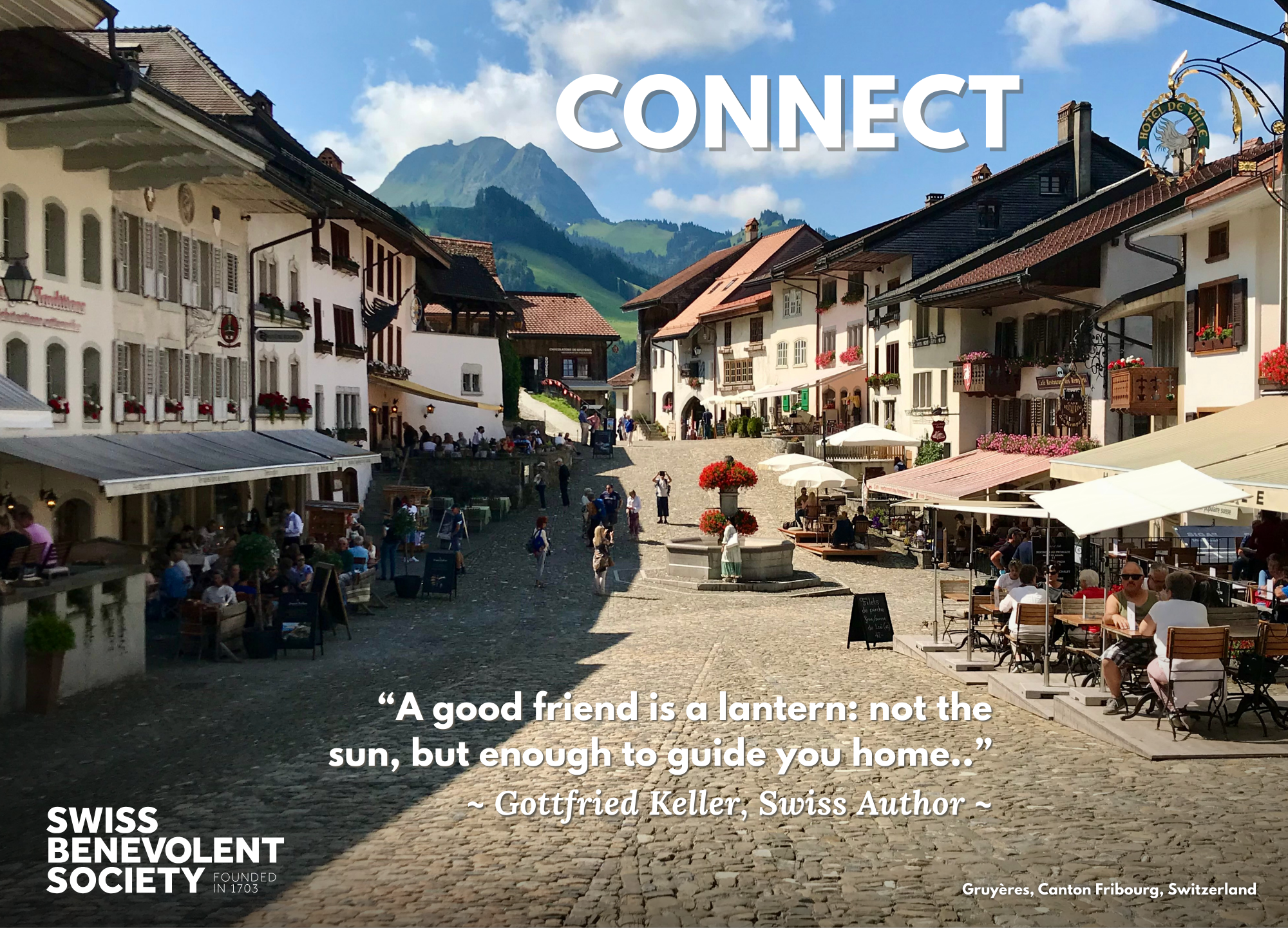
July – CONNECT
Prompt of the Month: Pass on one piece of advice that helped you through a hard time, or one habit that shaped you.
Think of a teacher who said something to you once, a sentence offered in passing, that lodged itself so thoroughly that it is still with you decades later. Or a colleague in your first job who showed you, not by explaining but by demonstrating what it looked like to handle pressure with composure. Or a parent who said the thing you did not know you needed to hear, at exactly the right moment, in a way that made you feel both seen and capable. Most of us, when we trace back what shaped us, find that the path leads not to solitary effort but to exchange: the advice that arrived when it was needed, the habit passed on because someone thought you were worth the effort of passing it on to, the example set by someone who was not even aware they were setting it.
In Gottfried Keller’s quote we see this spirit captured.
“A good friend is a lantern: not the sun, but enough to guide you home.”
~ Gottfried Keller ~
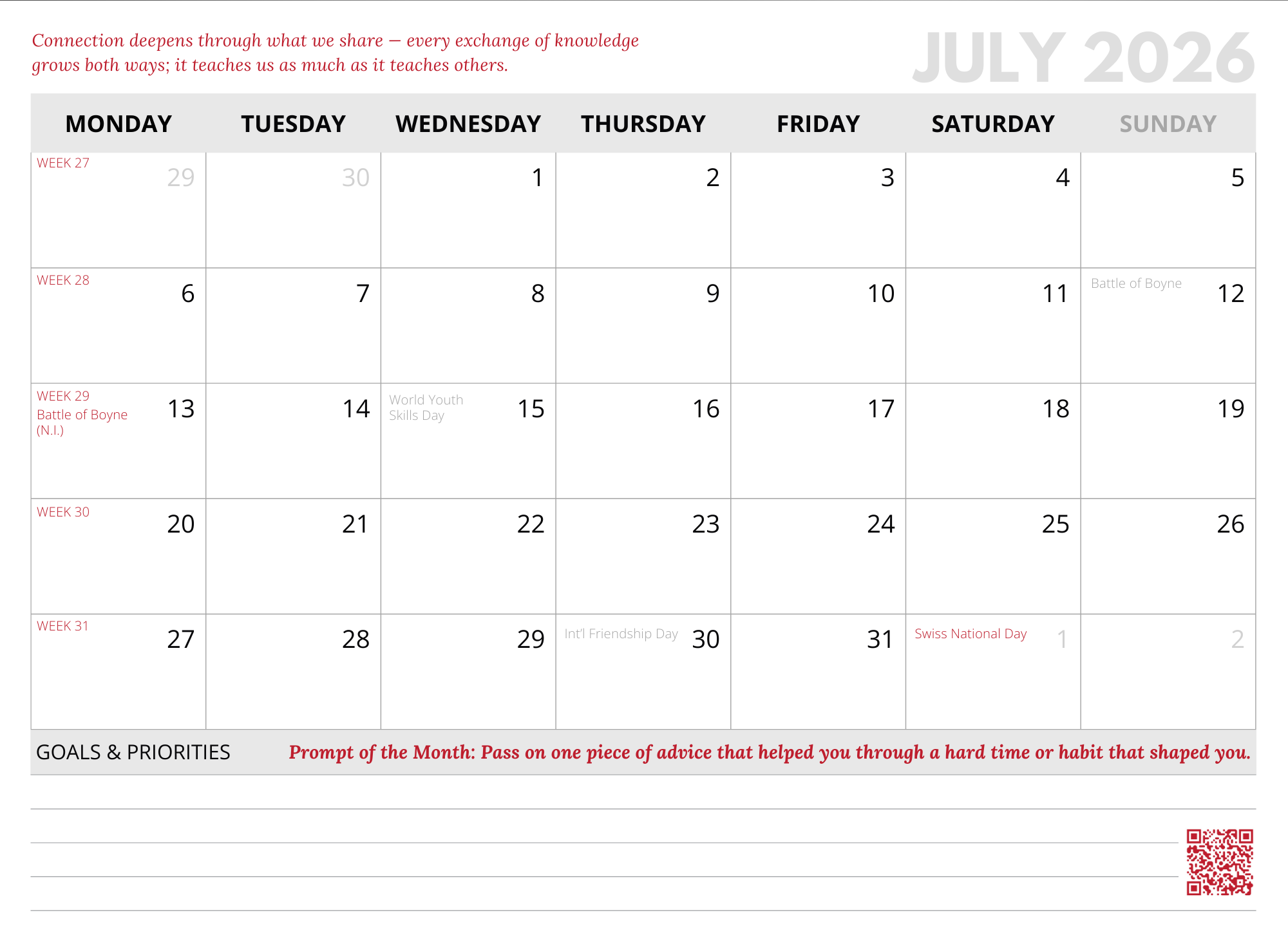
To explain it further, July’s calendar carries a line:
“Connection deepens through what we share – every exchange of knowledge grows both ways; it teaches us as much as it teaches others.”
That is the particular quality of connection we are hoping to explore. Not the passive warmth of being near someone, but the active exchange. Knowledge shared between people, experience made useful by being spoken rather than kept, something earned through living and offered freely to the next person who is standing where you once stood. When we share what helped us, we do not lose it. We come to understand it more fully, and the person receiving it gains something they could not have assembled alone.
From Embrace to Connect – A Thought from Lily, Our Welfare Officer
June encouraged us to pause before reacting – to create a small space between what happens and how we respond. That pause is valuable not only because it helps us understand ourselves, but because it shapes the way we connect with others.
In my role as Welfare Officer, supporting Swiss nationals across the UK, I’ve seen how closely wellbeing and connection go hand in hand. During difficult times, it’s easy to withdraw from the very people who could help us most. Yet meaningful connections are an important foundation and remind us that we don’t have to navigate life’s challenges alone.
Connection doesn’t have to be a grand gesture. It can be checking in on a friend, accepting help when it’s offered, making time for the people and activities that help us feel grounded, or simply listening without judgement. These small moments strengthen both our own wellbeing and the communities around us.
July invites us to share what has helped us – our experiences, encouragement and kindness. At the heart of welfare is a simple truth: when we stay connected, we create communities where people feel seen, supported, and able to thrive together.
What We Carry, and What We Pass On
For Swiss nationals living in the UK, connection carries a dimension that is worth naming directly, because it is one of the most active and creative forms of connection this community practises: the cultivation of Swiss identity across distance, across generations, and across the particular complexity of building a life between two countries.
Not in the sense of preserving a museum exhibit about Swissness, but rather something alive and ongoing. The parent who speaks Schwiizerdütsch with their children in a London household, not because it is practical but because language carries something that cannot be translated – a way of thinking, a rhythm of expression, a living thread back to grandparents and schoolmates and the specific texture of a place. The family that marks Swiss National Day with the same care they would have given it in Bern or Basel, not out of habit but out of the conviction that cultural continuity is worth the effort. The Swiss school calendar kept alongside the British one, so that children understand both systems and feel at home in neither at the expense of the other.
These acts of passing down culture and identity are a form of connection in the fullest sense. They build something in the people who receive them. A richer sense of who they are and where they come from, a greater capacity to move between worlds without being lost in either, or the kind of grounded identity that turns out to be useful precisely when life becomes uncertain. Swiss values around civic responsibility, directness, the importance of reliability and craft, a serious relationship with landscape and season are not stereotypes when they are lived rather than performed. They are inheritances, and they are passed on through connection: through conversation, through shared ritual, through the thousand small decisions a family makes about what matters enough to keep.
And then, of course, there is the FIFA World Cup.
The 2026 tournament kicked off on 11th June, and whatever your personal relationship with football, there has been something worth observing about what happens to Swiss nationals abroad the moment Switzerland plays. Group chats that have been dormant for months suddenly ignite. The Swiss pub in the city fills with people who did not know each other an hour before and are now, for the duration of ninety minutes, entirely certain that they do. Flags appear in the windows. Someone makes Rösti. The shared identity that is easy to take for granted in daily life becomes, briefly and joyfully, unmistakable. With the group stage behind us and Switzerland preparing to face Algeria in the early hours of 3rd July UK time, the collective watching continues — and so does the sudden, uncomplicated sense of community it creates. Connection, in those moments, requires no effort at all. It is already there, waiting to be reminded of itself.
It is worth asking, in quieter moments, how to carry some of that ease into the rest of the year.
Connection does not always require being the sun for someone. Sometimes a small light is enough for the next step.
A Month of Thresholds
Across the UK and in Switzerland, July marks a particular kind of crossroads for students and young people. In England, Wales and Northern Ireland, A–level and GCSE results season is approaching, and with it the decisions. University places, gap years, apprenticeships, first jobs – decisions that feel enormous in the moment even when, with hindsight, they turn out to be one of many chances to change direction. In Scotland, Higher and Advanced Higher results arrive in early August, but the end of the academic year brings its own sense of threshold. Swiss students navigating the maturité or the IB, whether at home or at international schools in the UK, are at their own version of this crossroads.
Over the years, we have noticed this and tried to respond in ways that are actually useful. Through our student grants and bursary programmes, we offer practical financial support to Swiss nationals in further and higher education across the UK – support that can make the difference between a student being able to continue and having to stop. We also work closely with the Swiss student community at Cambridge, where our pre–exam breakfast earlier this year brought students and the SBS together at exactly the right moment – not with advice or pressure, but with the message that they were not going through it alone. If you know a young Swiss national who might benefit from our support, please do pass the information on.
The United Nations designates 15th July as World Youth SkillsDay – a reminder that what young people carry into adult life extends well beyond academic results. The ability to navigate systems, to ask good questions, to build something from the materials available, to tolerate uncertainty while continuing to move forward, to learn from someone who has already been where you are going: these capacities are almost always developed in relationship. They grow through connections.
A Practical July Experiment
This month’s prompt asks you to pass on one piece of advice that helped you through a hard time, or one habit that shaped you.
To do that well, begin by looking back honestly. Not every piece of advice we received was useful. Some sounded wise but did not fit the reality of our lives. Some we ignored at the time and only understood years later. Some habits were taught deliberately; others were absorbed quietly by watching how someone else lived.
The question is not: What sounds impressive?
The question is: What actually helped?
Perhaps it was a sentence that steadied you during a difficult season. Perhaps it was a practical habit that gave structure to your days. Perhaps it was something a parent, teacher, colleague, friend or grandparent repeated so often that it became part of how you move through life.
The exchange between generations can be one of the most underused forms of connection available to us, and the prompt this month is an invitation to put it back into circulation, in both directions.
Here are four ways you might act on it:
- Pass on one sentence that helped you through a hard time.
Think of a phrase, reminder or piece of advice that genuinely carried weight when life was difficult. Then share it with someone who may need it now — a young person waiting for results, a friend under pressure, a colleague starting something new, or someone quietly facing change. Keep it simple. One honest sentence can be more useful than a long speech. - Share one habit that shaped you.
Choose a habit that has genuinely supported your life: writing things down, taking a walk before making a decision, phoning someone before worry grows too large, preparing for the next day before going to bed, keeping Sunday quiet, learning a few words of a family language, or making time for prayer, reflection, sport or craft. Tell someone not only what the habit is, but why it helped you. - Ask someone what they would pass on.
Turn the prompt around. Ask a parent, older friend, colleague, neighbour or someone from another generation: What is one piece of advice or one habit that helped you more than you expected? Then listen properly. Some of the most useful knowledge in a community is never written down because nobody thinks to ask for it. - Pass on a skill, not only advice.
Connection is often built through doing. Teach someone a recipe, a phrase in a family language, a budgeting habit, a practical shortcut, a professional lesson, a repair, a craft, or the small routine that helped you manage a demanding season. A skill says more than “I care”; it says, “I believe you can carry this forward.”
Some of these exchanges happen one to one. Others happen when a community makes room for them, which brings us to two dates worth marking in your diary.
Connecting in July and August:
Two Dates for Your Diary
A Taste of Ticino – Saturday, 11 July 2026, 10am-12pm
Our Tea, Coffee & Good Company series begins on Saturday 11th July, 10am–12pm, with A Taste of Ticino – a relaxed morning of coffee, conversation and Swiss–Italian culture, hosted in the Endell Street Gallery Room at 79 Endell Street in London.
In partnership with Unione Ticinese, the session explores the traditions, heritage and flavours of Switzerland’s Italian–speaking canton through cultural insights, traditional Ticinese refreshments, and a friendly Ticino–themed quiz with a small prize. The morning will also include a beginner–friendly Italian language taster led by a tutor from International HouseLondon – a fun, informal introduction to a handful of useful phrases, and a reminder that even a few words of a new language can open a door.
There is a small piece of history that makes the venue particularly fitting: International House London opened its first premises on Endell Street in 1957, the very street where we are gathering. The event is open to Swiss nationals and their families living in the UK, and tickets are free but places are limited, so advance booking is recommended. Book your free place HERE on Eventbrite. If you have specific accessibility requirements or would like to let us know in advance that you will need assistance, please email us at community@swissbenevolent.org.uk and we will make sure someone is ready to welcome you at the door.
Swiss National Day London – Saturday, 01 August 2026, 2pm-6pm
Looking ahead: on 1st August, Switzerland’s National Day, the SBS will be present at the London celebrations with our Welfare Officer Lily available to meet Swiss compatriots, answer questions about our work, and be a familiar face from the community. If you are planning to attend – details at snd–london.com – please do come and say hello. We will report back on the day in our August post.
Location: Crypt on the Green, St James Church, Clerkenwell Close, London EC1R 0EA
📚 What We’re Reading at SBS This July
Reading is one of the more private forms of connection we practice – and one of the more generous, when we share what a book has given us. This month, we have begun something new on the blog: short personal reading notes from members of the SBS team. These are not formal SBS endorsements or curated recommendations. They are simply books that have stayed with members of our team, shared in our own words, in case one of them speaks to you too.
📖 Lily’s Pick: Together by Vivek H. Murthy
🔗 Why it connects: TOGETHER explores how connection is a fundamental human need and how loneliness can affect both our emotional and physical wellbeing. It highlights the importance of meaningful relationships, community, and staying connected, especially during life’s more challenging moments.
💡 What stayed with me: What has stayed with me most is the reminder that meaningful connection isn’t just about being surrounded by people—it’s about feeling seen, valued, and understood. It has made me think more about the quality of our relationships and how even small moments of genuine connection can have a lasting impact.
Lily, our Welfare Officer, writes: “So far, I have found the book engaging through its combination of personal stories and research, and highly relevant to the loneliness epidemic that so many people are facing today. It explores both the impact of loneliness on our wellbeing and the power of connection and meaningful relationships in helping us thrive. I’ve found it particularly interesting to reflect on the differences across cultures, genders, and generations in how loneliness is experienced. The discussion around technology is also thought-provoking, while it promised to bring us closer together, it can sometimes have the opposite effect. I’m really enjoying the book so far and look forward to continuing it.”
🔗 https://www.goodreads.com/book/show/43309159-together
📖 Nadine’s Pick: Knulp by Hermann Hesse
🔗 Why it connects: Not every connection is permanent, but some still leave a trace.
💡 What stayed with me: A life does not need to look conventional to have touched many others.
Nadine, our Office Administrator and Company Secretary, writes: “When I first started KNULP, I assumed I was meeting a vagabond – someone drifting through life on the goodwill of others. I was wrong.
Knulp is a wanderer, but not a careless one. He has a talent for conversation, an honest curiosity about the people he meets, and a way of making them feel seen even when he never stays long enough to belong to them. He carries himself with dignity – clothes mended, little book in order – and wherever he goes, he leaves something behind. A moment of relief for a homesick maid. A friend whose ordinary thoughts open into something larger. A door back, for old acquaintances, to who they once were.
The people around him hold a strange double feeling toward him: pity for the life he never built, and envy for the freedom he seems to carry so lightly. In the final part of the book, Knulp almost gives in to the pity himself. Homesick, ageing, and weighed down by memories of what might have been, he comes close to believing he wasted his life. Only at the very end does he understand that his worth was never in what he settled into, but in what he gave to the people whose lives he briefly touched.”
🔗 https://www.goodreads.com/book/show/24854.Knulp
📖 A SBS Team Pick: 30 Animals That Made Us Smarter by Patrick Aryee
🔗 Why it connects: Connection with nature can change the way we see the world around us.
💡 What stayed with me: The natural world does not only give us beauty; it shares knowledge too, if we are willing to pay attention.
“Summer always pulls me outdoors – to the mountains, to the sea, to the lakes and streams I have known for years – and this book has changed the way I look at almost everything I encounter there. Patrick Aryee’s 30 Animals That Made Us Smarter opened my eyes to the extraordinary minds behind creatures I see all the time and know almost nothing about.
Each short chapter takes one animal – its quiet genius, its unexpected problem-solving, the way evolution has equipped it with something we humans have spent decades trying to design – and shows me how much of our own ingenuity has been borrowed, knowingly or not, from the natural world. I have found it a wonderful family read, and equally good as a single chapter shared with a friend over coffee. It is the sort of book that gives you a small piece of wonder to carry into the rest of your day.”
📖 Prefer to borrow instead of buy?
Many of these books are available for free through local libraries. If you prefer to borrow rather than buy, you can search for nearby copies via WorldCat at local libraries via:
👉 https://www.worldcat.org
Closing Reflection
Connection is built from an accumulation of smaller decisions, most of them unremarkable at the time: the advice offered to someone who was at a threshold and needed a perspective they could not yet generate for themselves, the habit described because it might save another person a longer route to the same destination, the friendship tended carefully enough to survive the years and the distance and the changed circumstances that life puts between people. Most of the connections that have genuinely shaped us took shape through people who were not aware they were doing anything significant – and who may never have learned what difference they made.
For those of us building lives between countries, the act of connection carries an additional weight and an additional richness. Every time a language is kept alive at the dinner table, every time a Swiss tradition is marked in a British home, every time a child is given enough of both worlds to feel genuinely rooted in their own identity, something is being passed on that no school curriculum provides. That, too, is what this month is asking us to notice: that we are already connecting, already instilling, already building in others something that will outlast the effort it took.
Gottfried Keller’s lantern does not illuminate the whole road. It offers enough light for the next step, and for the person walking beside you to find their footing alongside your own. You do not need to be the whole answer for anyone. You need only to consider what particular light you carry – the knowledge that shaped you, the habit that held you steady, the perspective that arrived from someone who had already made the crossing – and to offer it when the person next to you could use it. What you pass on does not diminish in the giving. It is precisely the kind of thing that grows.
Pass it on.
And carry on.
Join Our 2026 SBS Year of Steady Progress
This journey continues through our monthly blog, where each theme will come to life with practical insights, reflections, and coaching tools to help you stay steady through the year.
Accessing the Calendar
To ensure everyone in our community can take part, we have made the full PDF version of the SBS 2026 Wall Calendar available to download for free on our website.
If you would prefer a hardcopy, you are very welcome to contact our office. We will be happy to post one to you. We currently have a limited number of printed copies remaining, available on a first-come, first-served basis; in return, we would gratefully appreciate a Donation of any amount. As always, 100% of proceeds go directly back into the SBS Welfare Fund, supporting Swiss nationals in the UK who need us most.
👉 Download the PDF: SBS 2026 Calendar A4
👉 Request a hardcopy: info@swissbenevolent.org.uk
READ OUR OTHER BLOGS HERE:
- Beneath the Noise: An October Reflection on GROUND
- Disconnect to Reconnect: A Digital Wellbeing Afternoon in London
- Given Away, Not Gone: A September Reflection on Share
- Where the Forest Begins: An August Reflection on Unite
- Annual Summer Office Break
About the Swiss Benevolent Society
The Swiss Benevolent Society exists to support Swiss nationals in the UK through times of change, challenge, and transition. Our work is grounded in dignity, compassion, and the belief in self-reliance — offering practical help while empowering individuals and families to regain stability and confidence. If you or someone you know may need support, you can learn more about how we help and how to get in touch through our Welfare Office. If you share our values and would like to be part of our community, we welcome you to become a member and stay connected with our work. And if you are able, donations — of any size — help us continue providing vital assistance; every contribution goes directly back into our welfare programmes.
Stay Connected
Follow us on Facebook, Instagram or LinkedIn for monthly reflections, book highlights, and gentle wellbeing reminders.
Subscribe to our newsletter to receive each month’s theme directly in your inbox.
If you are able, donations help sustain our welfare work and ensure we can continue supporting Swiss nationals in the UK. Every contribution makes a difference.