The Rhythm Beneath the Routine: A Reflection on What It Means to Thrive
Thursday, April 30th, 2026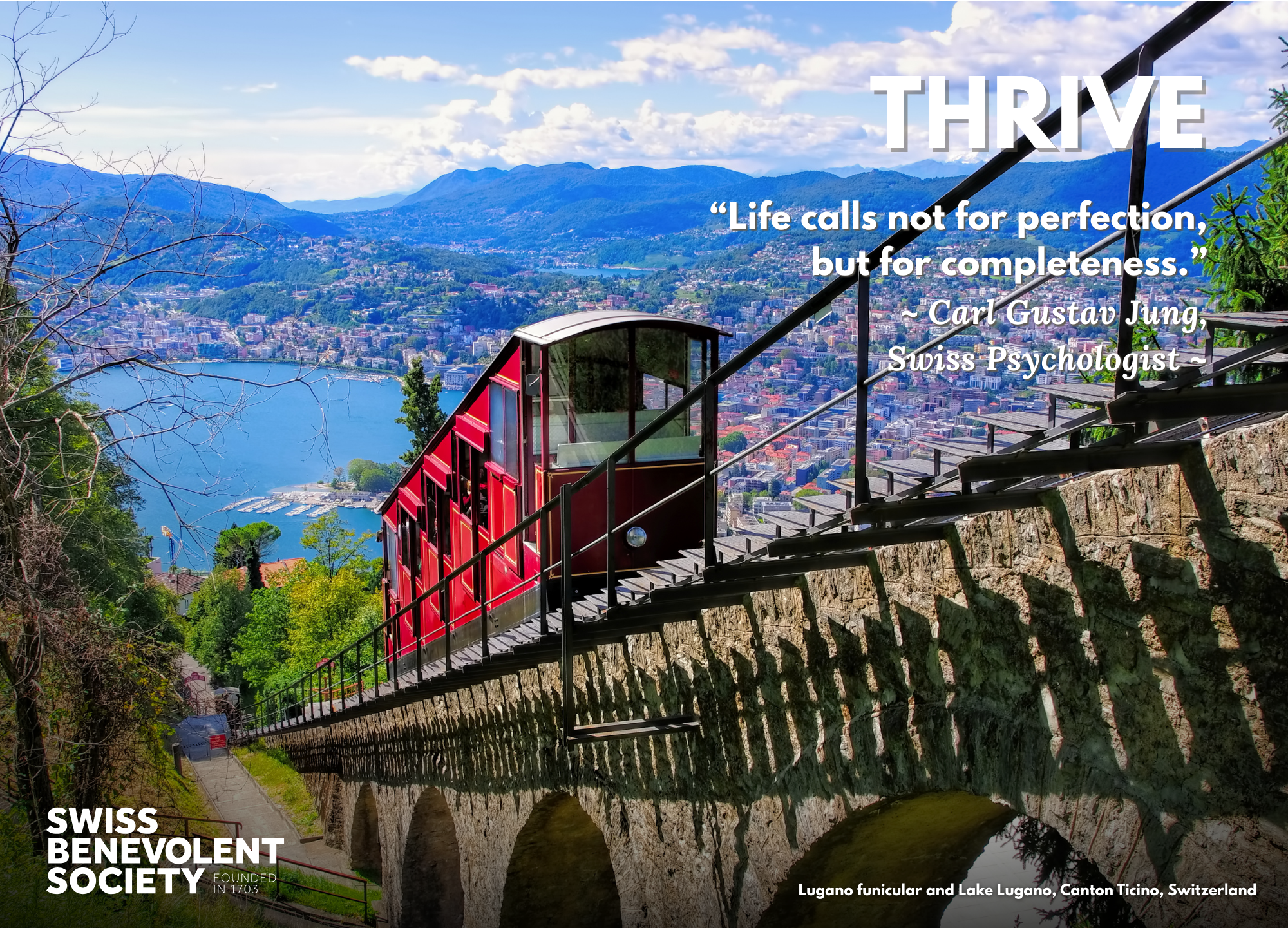
May – THRIVE
Growing at Your Own Pace
Prompt of the Month Add something nourishing to your routine — food, rest, laughter, or light.
Above Lake Lugano, there is a funicular that has been running the same route for well over a century. It operates on a fixed schedule, does exactly what it promises, and carries people efficiently between two places — a model, in that sense, of well-organised life. Yet anyone who has taken that ride, watching the city drop away below and the water open out behind it, will know that the experience is not really about the journey at all. It is about what the vantage point gives you: the chance to look at everything from a different angle and, for a moment, to stop calculating the most direct route forward.
That pause is where the May theme begins.
Most of us spend a remarkable amount of energy organising life. Calendars fill quickly. Responsibilities stack neatly on top of one another. Weeks move forward with impressive efficiency, and from the outside, everything appears to run exactly as planned. Yet organisation alone does not create a life that feels nourishing — and after the adjustments explored in April, May invites a different perspective. Instead of asking how to improve the structure of our routines, we begin asking a more interesting question:
Does the life we organise also sustain us?
This is where the idea of thriving begins.
Not More, But Different
Thriving does not mean doing more or accelerating the pace of life. It asks something deeper — whether the rhythm of our days contains enough nourishment to sustain the people living inside them.
The calendar’s quote for this month comes from Carl Gustav Jung: “Life calls not for perfection, but for completeness.” It is worth sitting with that word for a moment. Completeness is not the same as productivity. It includes curiosity, companionship, rest, and genuine enjoyment alongside responsibility. A week filled exclusively with obligation may function perfectly well. But a life measured only through its output — tasks completed, goals reached, boxes ticked — will eventually begin to feel hollow, even when it is running at full capacity.
Robert Waldinger and Marc Schulz, the researchers behind the Harvard Study of Adult Development, describe a concept they call social fitness: the understanding that relationships and shared experience sustain us with the same necessity that physical health does. Over eighty years of data, the single most consistent finding was not about diet, exercise, or professional achievement. It was about connection. The quality of our relationships shapes our health, our resilience, and our sense of meaning far more reliably than any individual habit we might try to install or optimise.
Seen from that perspective, thriving is not a personal project. It is an ecology — and it requires the same ongoing attention we give to everything else we consider important.
The Case for Adding Rather than Fixing
When people feel depleted, the instinct is to fix life by removing something. Cancel the commitment. Reduce the schedule. Simplify the week. Those decisions can certainly help. But another approach can create a surprisingly powerful shift: instead of beginning with subtraction, begin with addition.
Add something that restores rather than consumes — a conversation with someone whose perspective steadies you, a walk that marks the end of the workday rather than bleeding into the evening, a proper meal eaten without the television on, a book opened before bed instead of another hour of news.
These additions may appear minor when viewed individually. Over time they reshape the atmosphere of daily life, and the day begins to contain sources of energy again rather than operating solely as a chain of responsibilities to be dispatched. This is precisely what the calendar prompt for May invites: add something nourishing to your routine — food, rest, laughter, or light. The simplicity of that instruction is deliberate. Thriving does not require dramatic reinvention. It begins with environments that actively support the people living inside them.
Where Nourishment Shows Up in Real Life
Pause for a moment and consider this: what actually restores you during an ordinary week?
The answer shifts considerably depending on the stage of life someone occupies.
For students and young professionals, nourishment may appear in small moments of genuine autonomy — decisions that restore a sense of control within an otherwise demanding schedule. Choosing how to spend an evening after a long day of lectures. Taking a walk before returning to a shared flat. Calling home and hearing a familiar voice from Switzerland. These are not grand gestures. They are the small anchors that prevent a demanding week from becoming a depleting one.
For families raising children, nourishment can look entirely different. Days are carefully orchestrated between school runs, work schedules, homework, and household logistics. In that environment, thriving is not built on grand gestures. It takes shape through shared rituals: a proper dinner together, a conversation before bedtime, a Saturday outing that interrupts the rhythm of the working week and reminds everyone — adults included — that life contains more than its obligations.
Later in life, the shape of nourishment shifts again. This is where Waldinger and Schulz’s research becomes most striking. The people who reported the greatest satisfaction in their later years were not those who had been most productive or most accomplished. They were the people who had maintained relationships with the same deliberate care that others gave to their careers. Social fitness, as they describe it, is not a natural by-product of time passing — it requires attention and intention, the same kind of ongoing investment that any meaningful part of life requires.
Which leads to the question worth returning to throughout this month: Which moments in your own week leave you feeling more energised afterwards than before them?
Those moments are already showing you where nourishment is waiting.
A Practical Experiment for the Month Ahead
April was an invitation to notice — what drains you, what restores you. May asks the logical next question: now that you have seen it, what will you actually do about it? Consider introducing one nourishing element into your routine this week and observing the effect over several days:

- Step outside in the afternoon rather than eating lunch at a desk — even fifteen minutes changes the texture of the rest of the day.
- Arrange a regular coffee with someone whose company lifts your mood and protect it in the diary as you would any other commitment.
- Close the laptop earlier on one weekday evening and allow the evening to unfold without a task attached to it.
- Add one meal a week that is eaten properly — at a table, without a screen, with enough time to actually finish it.
Small adjustments accumulate. Over time they shape the atmosphere of life far more reliably than occasional dramatic changes. The experiment is not to overhaul the week. It is simply to notice what happens when nourishment returns to the routine.
📚 This Month’s Good Reads
These recommendations explore different ways of thriving — from redefining success and supporting children’s resilience to understanding the role of relationships in long-term wellbeing.
THRIVE – ARIANNA HUFFINGTON
A thoughtful reflection on redefining success beyond constant productivity and burnout. Huffington argues that wellbeing, wisdom, wonder, and meaning belong at the centre of a sustainable life rather than being postponed for later. Her central argument is especially relevant in a culture where achievement can easily become detached from health, rest, and perspective. Thrive invites readers to reconsider what success actually costs when life is measured only through work, output, or external recognition.
Why it fits May: Thriving is not about doing more. This book supports the month’s theme by asking readers to widen their definition of success and include the habits and values that make life sustainable.
Best for: Students, professionals, and anyone navigating demanding studies or career pressures while trying to build a healthier rhythm of life.
🔗 https://www.goodreads.com/book/show/18594634-thrive
THE THRIVING CHILD – WILLIAM STIXRUD & NED JOHNSON
An insightful exploration of how children build resilience, confidence, and independence when they develop a healthy sense of autonomy. Instead of trying to control every outcome, Stixrud and Johnson encourage parents to become supportive guides, helping children build responsibility and self-trust. The book is particularly useful because it does not frame thriving as pressure to perform — it examines how stress reduces when children feel some appropriate control over their lives, decisions, and learning.
Why it fits May: This month’s prompt asks us to add something nourishing to our routine. For families, that nourishment may include creating a home rhythm where children feel supported, heard, and gradually trusted to grow at their own pace.
Best for: Families, parents, and carers navigating school pressure, exams, independence, and the challenge of maintaining a nourishing home environment.
🔗 https://www.goodreads.com/book/show/39217355-the-thriving-child
THE GOOD LIFE – ROBERT WALDINGER & MARC SCHULZ
Based on more than eighty years of research from the Harvard Study of Adult Development, this book examines what contributes to long-term happiness, health, and emotional wellbeing. Its central discovery is refreshingly straightforward: strong relationships play a defining role in how well we live. Waldinger and Schulz describe the importance of maintaining our relationships with the same care we might give to physical health, using the term social fitness to capture this ongoing practice.
Why it fits May: Thriving is not only about personal habits. This book is a reminder that nourishment also comes through connection, companionship, and the relationships we continue to tend over time.
Best for: Readers at any stage of life who have noticed that friendships slip as life grows busier — and want to understand what actually sustains long-term wellbeing and how to tend to their relationships with real intention.
🔗 https://www.goodreads.com/book/show/61272271-the-good-life
📖 Prefer to borrow instead of buy?
Many of these books are available for free through local libraries. If you prefer to borrow rather than buy, you can search for nearby copies via WorldCat at local libraries via:
👉 https://www.worldcat.org
Closing Reflection
Thriving is not a permanent state we achieve once and keep forever. It develops through an ongoing exchange between effort and restoration, responsibility and nourishment — and it tends to grow in the gaps we deliberately protect rather than the hours we optimise.
May invites us to look at the rhythm of our days with fresh attention and ask whether the life we organise also sustains us. The answer, when it comes, is usually found in something reassuringly ordinary: a conversation held without a phone on the table, a meal that takes longer than strictly necessary, an evening with nothing scheduled at the end of it. When nourishment returns to the routine, the week starts to feel like something worth living inside — not just something to get through. And that is where thriving begins.
Let the week contain more than its obligations.
And carry on.
Join Our 2026 SBS Year of Steady Progress
This journey continues through our monthly blog, where each theme will come to life with practical insights, reflections, and coaching tools to help you stay steady through the year.
Accessing the Calendar
To ensure everyone in our community can take part, we have made the full PDF version of the SBS 2026 Wall Calendar available to download for free on our website.
If you would prefer a hardcopy, you are very welcome to contact our office. We will be happy to post one to you. We currently have a limited number of printed copies remaining, available on a first-come, first-served basis; in return, we would gratefully appreciate a Donation of any amount. As always, 100% of proceeds go directly back into the SBS Welfare Fund, supporting Swiss nationals in the UK who need us most.
👉 Download the PDF: SBS 2026 Calendar A4
👉 Request a hardcopy: info@swissbenevolent.org.uk
READ OUR OTHER BLOGS HERE:
- Beneath the Noise: An October Reflection on GROUND
- Disconnect to Reconnect: A Digital Wellbeing Afternoon in London
- Given Away, Not Gone: A September Reflection on Share
- Where the Forest Begins: An August Reflection on Unite
- Annual Summer Office Break
About the Swiss Benevolent Society
The Swiss Benevolent Society exists to support Swiss nationals in the UK through times of change, challenge, and transition. Our work is grounded in dignity, compassion, and the belief in self-reliance — offering practical help while empowering individuals and families to regain stability and confidence. If you or someone you know may need support, you can learn more about how we help and how to get in touch through our Welfare Office. If you share our values and would like to be part of our community, we welcome you to become a member and stay connected with our work. And if you are able, donations — of any size — help us continue providing vital assistance; every contribution goes directly back into our welfare programmes.
Stay Connected
Follow us on Facebook, Instagram or LinkedIn for monthly reflections, book highlights, and gentle wellbeing reminders.
Subscribe to our newsletter to receive each month’s theme directly in your inbox.
If you are able, donations help sustain our welfare work and ensure we can continue supporting Swiss nationals in the UK. Every contribution makes a difference.